

Smart City Expo Miami Highlights Human-Centered Innovation
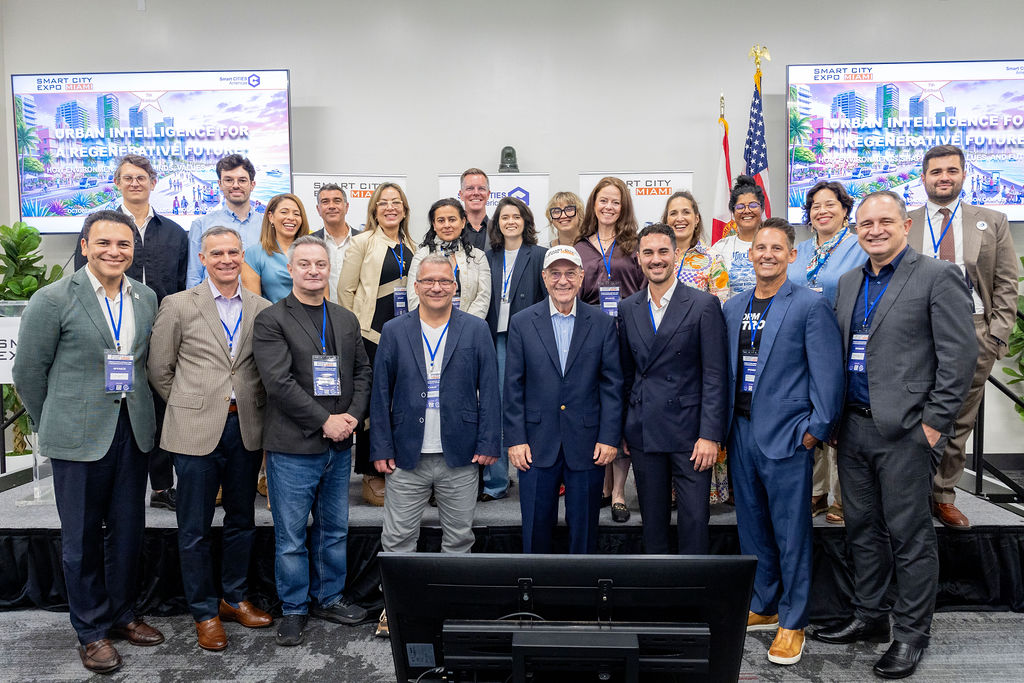
SPEAKERS - SMART CITY EXPO MIAMI
Second Conference Day program connects urban resilience, predictive governance, community engagement, and regenerative design through international case studies
The program connected regenerative ambition with implementation: better decisions, meaningful participation, responsive design, and partnerships capable of translating ideas into lasting urban value.”
MIAMI, FL, UNITED STATES, October 13, 2026 /EINPresswire.com/ -- The second day of Smart City Expo Miami — Urban Intelligence for a Regenerative Future held on October 6, 2026 brought together international speakers to explore how cities can move beyond operational efficiency toward lasting environmental and social regeneration.— Bernardo Scheinkman, CEO of Smart Cities Americas
Presentations connected technology with leadership, trust, public investment, and human well-being. Through case studies from municipal governments, businesses, universities, and community organizations, speakers examined how urban intelligence can strengthen essential services, improve decision-making, and help people reconnect with their neighborhoods and environments.
The program emphasized a shared principle: smarter cities must deliver more than better systems. They must create healthier, more inclusive, and more adaptable places to live.
Resilience Begins with People
Dr. Edna Pasher and Adi Saranga of Edna Pasher & Associates in Tel Aviv presented “Lessons from Smart Cities During Crisis,” identifying leadership, collaboration, and preparedness as critical dimensions of resilience. Their presentation emphasized that technology supports resilience, while trust and human capability enable cities to function during disruption.
Prof. José Antonio Ondiviela of Universidad Francisco de Vitoria in Madrid expanded that perspective through “Beyond Resilient Cities: Social Restorative Cities.” He argued that recovery must address housing, employment, health, relationships, and belonging alongside infrastructure. His framework emphasized preparing support networks and restoration mechanisms before disasters occur.
Designing Environments That Support Well-Being
Núria Muñoz Arce of Habitarmonia in Valencia presented the Flourish Tree Model for regenerative urban design. Drawing on healthcare, corporate, and hospitality cases, she described reported outcomes including a 32% reduction in stress, a 15% increase in productivity, and 8.5% faster healthcare recovery times.
From Fragmented Information to Predictive Governance
Flávia Tissot of OSPA in Porto Alegre presented digital twin technology as operational infrastructure for predictive urban governance. Her Brazilian case study explored how unified territorial intelligence can help municipalities assess infrastructure capacity, climate exposure, and development potential before problems emerge.
Alejandro Quinto Ferrández of CommunityAI in Mallorca demonstrated how corporate program documents can become spatial intelligence. His presentation connected social responsibility strategies, funding briefs, and procurement commitments with geographically informed community investment decisions.
Andrea Macario of Enviro City and Augusto Ferrentino of SmartLeaf presented a Rome case study transforming street-sweeping vehicles into civic intelligence infrastructure through cameras, environmental sensors, and AI-based recognition.
Operational across Rome’s 15 Municipi since October 2024, the model reported annual sweeping coverage increasing from 18,000 to more than 55,000 kilometers, alongside reductions of 41% in non-productive miles, 35% in fuel consumption, and 30% in cost per kilometer.
Wojciech Ciesielski, CIO of Łódź City Hall, Poland, distinguished AI from automation. He emphasized that automating repetitive municipal tasks can free employees to address more complex responsibilities requiring human judgment.
Civic Participation as an Implementation Strategy
The “Why Civic Engagement Determines Success” panel featured Greg Chavarria of KEITH Engineering, Arlene Borenstein of the Town of Bay Harbor Islands, and Amber Cabrera of the City of Fort Lauderdale.
The discussion emphasized public understanding, community champions, and public-private collaboration as essential to implementing smart city initiatives.
Sabina Mihailescu of IntreVecini/DearNeighbour in Bucharest presented a neighborhood-led approach that has supported more than 100 active communities across 32 Romanian cities since 2021. Projects included communal gardens, apartment-block solar installations, and local festivals.
Her presentation highlighted the potential of identifying residents who already care about their neighborhoods and providing practical support for collective action.
Andy Boenau, Director of Transportation for Richmond, Virginia, connected Vision Zero and Complete Streets with safety, equitable mobility, and community engagement, emphasizing people-centered transportation innovation.
Infrastructure That Strengthens Connection
Michael Guthrie of INFORM Studio in Detroit presented the Skybridge Connector as more than a transportation link. His session explored how design can transform urban thresholds into destinations and connections into opportunities for shared purpose.
Ana Paula Wickert of Atitus Education examined the decade-long transformation of Parque da Gare in Passo Fundo, Brazil. The former degraded railway site became a public-space catalyst through integrated design, governance, and social activation, reconnecting residents with historic heritage.
Lindsay Humbles of Ocean Rescue Alliance International presented lessons from more than 300 artificial reef deployments in South Florida. Her session explored marine infrastructure as ecological habitat and a platform for education, wellness, cultural connection, and environmental stewardship.
Financing, Partnerships, and Adaptive Urbanism
Rodrigo Rocha, Head of OSPA Capital, explored how investor-project matching platforms, digital due diligence, and infrastructure intelligence can improve transparency and unlock capital for regenerative development in Brazil and Latin America.
The “Academic Smart City Partnerships” panel featured Sara Rushinek and Alexandra M. Vargas of the University of Miami, Avi Rushinek of Wiz-More-Biz, and Mark Hebert of the City of Coral Gables. Participants examined how university research and municipal testing can translate voice AI, computer vision, and IoT into citizen-centered services.
Matthew Claudel of Field States presented Adaptive Urbanism, emphasizing building reinvention, lightweight policy experiments, and investment strategies that help cities learn before scaling interventions.
Climate Action, Housing, and Urban Identity
Cristhyano Cavali da Luz of Curitiba presented a climate adaptation and decarbonization program spanning 478 schools, supported by US$50 million. Its four pillars address sustainable infrastructure, climate comfort, nature-based solutions, and extreme weather adaptation.
Remote speakers:
• Surabhi Kumari of Sucupira Designs in Ranchi, India, examined how material selection, daylight optimization, and passive ventilation supported well-being in a residential and workspace project.
• Juliet Chinemelu of Abuja, Nigeria, connected urban data with affordable housing, climate-adaptive infrastructure, and community engagement, positioning housing as a foundation for resilience.
• Maria A. El Helou of Anced in Beirut explored urban identity, memory, and embodied experience, emphasizing that reconstruction must consider how residents perceive, remember, and inhabit their city.
• Khathu Muruba of Pretoria, South Africa, explored Neuro-Urbanism, proposing that AI, digital twins, acoustic design, and tactile experiences could support empathy, memory, and belonging—not simply efficiency.
Together, the October 6 sessions framed urban intelligence as a practical means of strengthening public services, restoring environments, and supporting communities. The program connected regenerative ambition with implementation: better decisions, meaningful participation, responsive design, and partnerships capable of translating ideas into lasting urban value.
Bernardo Scheinkman
Smart Cities Americas
Visit us on social media:
LinkedIn
Instagram
X
Legal Disclaimer:
EIN Presswire provides this news content "as is" without warranty of any kind. We do not accept any responsibility or liability for the accuracy, content, images, videos, licenses, completeness, legality, or reliability of the information contained in this article. If you have any complaints or copyright issues related to this article, kindly contact the author above.
